CCS2 EV Charging PLUG [Technical Note]
Dual Functionality: Handles both slow/medium AC charging (using just the top Type 2 section) and ultra-fast DC charging (using the full combo port). Power Output: Typically ranges from 50 kW to 350+ kW (up to 1,000 V and 500 A).Compatibility: Standard on almost all modern pure-electric vehicles built or imported for European and regional markets, including brands like Volkswagen, BMW, Hyundai, and European Tesla models.
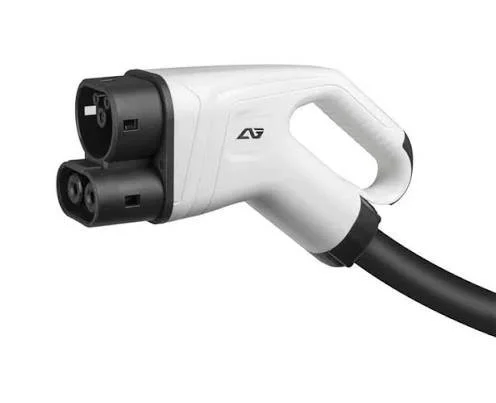
CCS2: The Combined Charging System Type 2 (CCS2) <shown on the right> is the standard DC fast-charging plug used for electric vehicles in Europe, Oceania, and much of the world. It combines a 7-pin Type 2 AC connector on top with two large DC pins on the bottom, supporting power outputs up to 350 kW or higher.
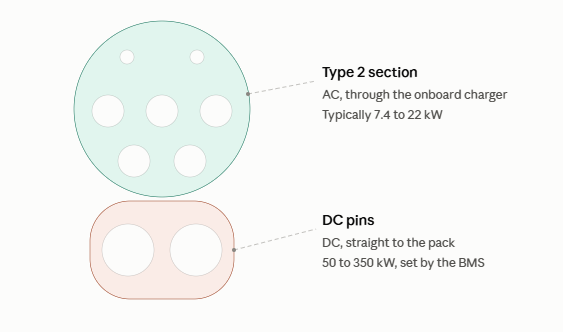
CCS2 layout: the flat top edge carries the two small signalling pins, and the five power pins sit below in a circular pattern — L1, L2, L3 across the upper arc, N and PE at the bottom, with PE the largest pin.
Power pins: L1, L2, L3 — the three phases, 230 V to neutral, 400 V line-to-line. Single-phase charging uses L1 only; L2 and L3 sit unconnected and the car simply doesn't know or care. The vehicle and charger negotiate via CP to determine available phases.
N — neutral, the return path for single-phase.
PE — protective earth, physically the largest contact and mechanically longer, so it makes first and breaks last. Non-negotiable on an off-grid site: with no utility earth, you need a proper earth electrode and a defined earthing arrangement (usually TT with your own rod, plus RCD protection) before the car will even accept a connection. Most EVs actively check PE continuity and refuse to charge if it fails.
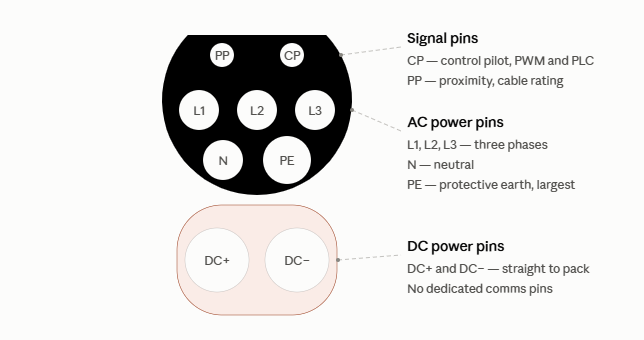
Signal pins — where the intelligence lives
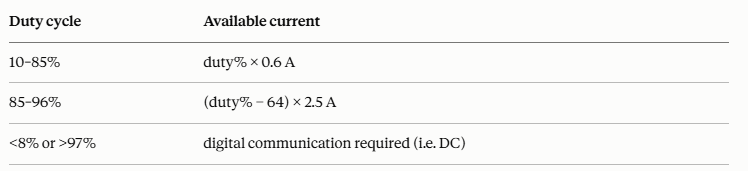
CP (Control Pilot) does most of the work. The EVSE (Electric Vehicle Supply Equipment) puts a ±12 V, 1 kHz square wave on it, and the duty cycle encodes how much current the station can supply.
In electric vehicle (EV) charging, duty cycle usually refers to the Pulse Width Modulation (PWM) signal on the Control Pilot line that tells the car how much electrical current it is allowed to draw. It ranges from 10% to 96% (signaling from 6A up to 65A+).
PP (Proximity Pilot) is much simpler: a resistor between PP and PE inside the cable's plug tells the car what the cable itself is rated for — roughly 1.5 kΩ = 13 A, 680 Ω = 20 A, 220 Ω = 32 A, 100 Ω = 63 A. It also tells the car something is plugged in, which is what stops you driving off with the cable attached.
The DC pins: DC+ and DC− go through contactors straight to the pack, bypassing the onboard charger entirely. CCS2 is specified to 1000 V and up to around 500 A with a liquid-cooled cable. High-current guns also carry PT1000 thermistors at the contacts, which the station must monitor and use to derate.
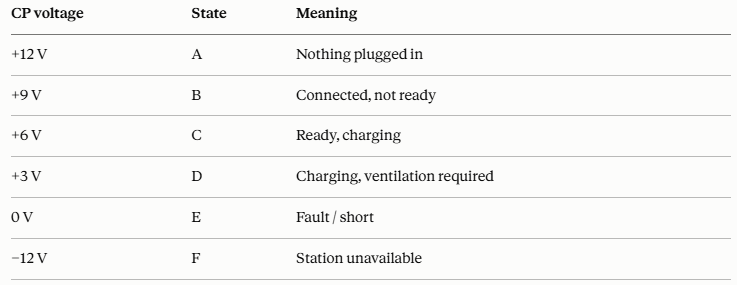
The car answers by pulling the CP voltage down through a diode-and-resistor network, which sets the charging state: